Autonomous Rideshare Fleets EV Charging
The Mobile EV Charging & Roadside Assistance vehicle delivers fast, on-demand power wherever fleets need it.

Check out Towel Mobility growing with L-Charge:
Site availability is one of the biggest constraints for autonomous rideshare depots.
L-Charge increases the number of viable locations by enabling charging at:
Through real-estate and parking partnerships, L-Charge helps fleets identify, evaluate, design, permit, and mobilize charging locations in weeks – not years. This creates a repeatable framework for multi-city AV expansion.
Traditional charging depots require significant upfront investment across hardware, construction, trenching, and utility upgrades – often exceeding $1M before the first vehicle charges.
L-Charge replaces this model with:
Because infrastructure buildout, utility upgrades, and long construction timelines are avoided, total cost per kWh can be lower than fixed infrastructure while dramatically reducing financial risk.
Autonomous fleets require infrastructure that is modular, repeatable, and operationally resilient.
L-Charge enables:
The result is infrastructure that behaves like software: deployable, adaptable, and replicable across cities.
For autonomous rideshare providers, charging is not a construction project – it is a growth enabler.
L-Charge allows operators to:
AV operators have used L-Charge to enter new cities quickly when grid-ready sites were unavailable, creating a scalable blueprint for future deployments.
A practical solution designed to keep fleets moving when infrastructure, capacity, or unexpected events create charging gaps.
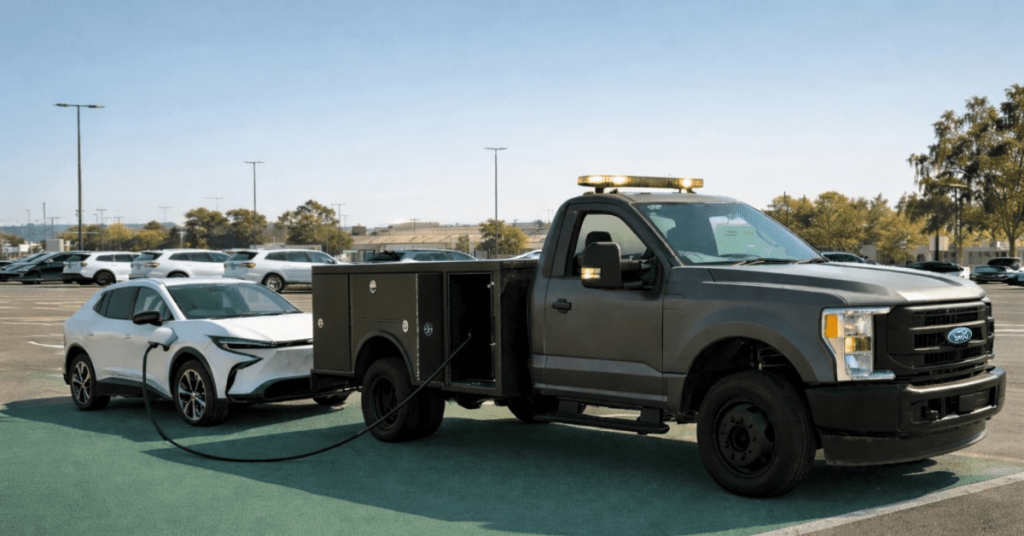
For autonomous rideshare fleets, charging infrastructure determines speed to market. L-Charge removes the bottleneck – enabling faster launches, faster scaling, and more efficient operations.