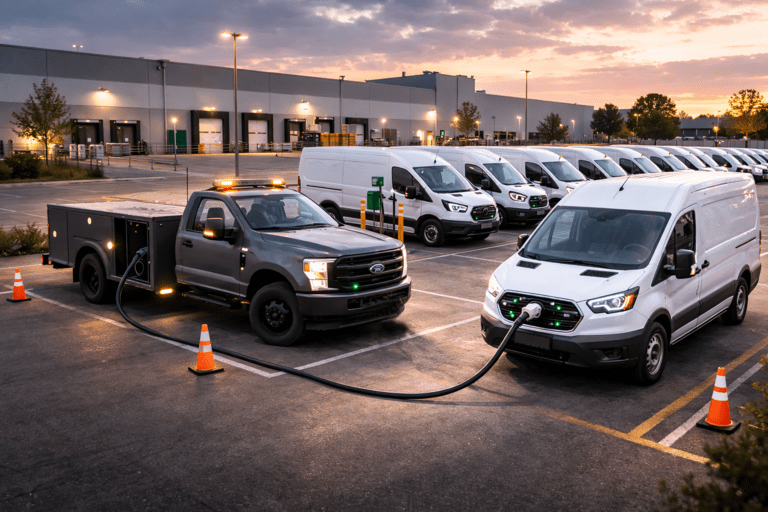
Last-mile fleets operate on tight delivery windows where vehicle availability directly impacts revenue and service levels. As fleets electrify, charging becomes a daily operational constraint, especially when depots lack sufficient power, vehicles return with low state of charge, or cold weather reduces available range. Fixed infrastructure, slow L2 charging, and moving vehicles between chargers create inefficiencies that limit fleet utilization.
July 23, 2025
Charging Built for Delivery Operations
Off-grid ultra-fast charging allows last-mile operators to deploy charging quickly, add capacity as fleets grow, and support high vehicle turnover across depots, micro-hubs, and temporary sites.
Mobile charging complements fixed infrastructure by delivering power directly to vehicles across yard rows, overflow parking, or satellite locations, eliminating unnecessary vehicle movement.
Moving vehicles between chargers increases labor and congestion
Charger downtime disrupts next-day readiness
These constraints reduce vehicle availability and limit route expansion.
How L-Charge Improves Last-mile Fleet EV Charging
Charge vehicles where they are parked Reduce yard movements and simplify overnight operations.
Add capacity without infrastructure projects Support fleet growth, seasonal peaks, and new depots immediately.
Increase vehicle readiness Ultra-fast charging enables faster turnaround between shifts.
Avoid demand charges and large CAPEX Predictable per-kWh pricing removes infrastructure risk.
Provide redundancy and operational resilience Mobile charging supports fleets when fixed chargers are down or fully utilized.
Mobile EV Charging
The Mobile EV Charging Truck enables flexible Last-mile Fleet EV Charging by delivering fast power directly to vehicles wherever they are parked or operating. It helps delivery fleets maintain vehicle readiness, manage peak demand, and avoid infrastructure delays that slow daily operations.
Brings DC fast charging directly to vehicles across depots, overflow parking, micro-hubs, and roadside locations
Supports fleets returning with low state of charge and needing rapid turnaround between shifts
Adds temporary charging capacity during peak delivery periods without infrastructure upgrades
Provides backup when fixed chargers are occupied or out of service
Enables rapid range recovery to keep vehicles route-ready
Reduces vehicle movement within yards, improving efficiency and safety
Compact, dual-purpose design integrates with standard fleet service workflows
Keeps last-mile fleets operational and scalable without waiting for grid expansion
Designed for Last-mile Fleet Workflows
Overnight depot charging support
Peak season capacity expansion
Micro-fulfillment and satellite hubs
New depot launches before grid readiness
Cold-weather range recovery
Overflow charging during high utilization periods
FAQ: Delivery Fleet EV Charging
Q: How quickly can I install EV charging for my delivery fleet? A: With L-Charge, chargers can be deployed in as little as 24 to 72 hours—no grid connection needed.
Q: Do I need to invest in charging infrastructure upfront? A: No, you don’t have to. Our Charging-as-a-Service model eliminates capital expenditures. You only pay for the energy your fleet consumes. However if you wish to own the hardware, there are cash purchase options.
Q: Can L-Charge support seasonal surges in delivery demand? A: Yes. Our modular, mobile system lets you scale up or down as needed without stranding assets. Mobile EV Charging Truck is perfect for such occasions.
Let’s Power Your Delivery Fleet
L-Charge helps you electrify your fleet on your terms with no grid dependency, no capital outlay, and no downtime.